
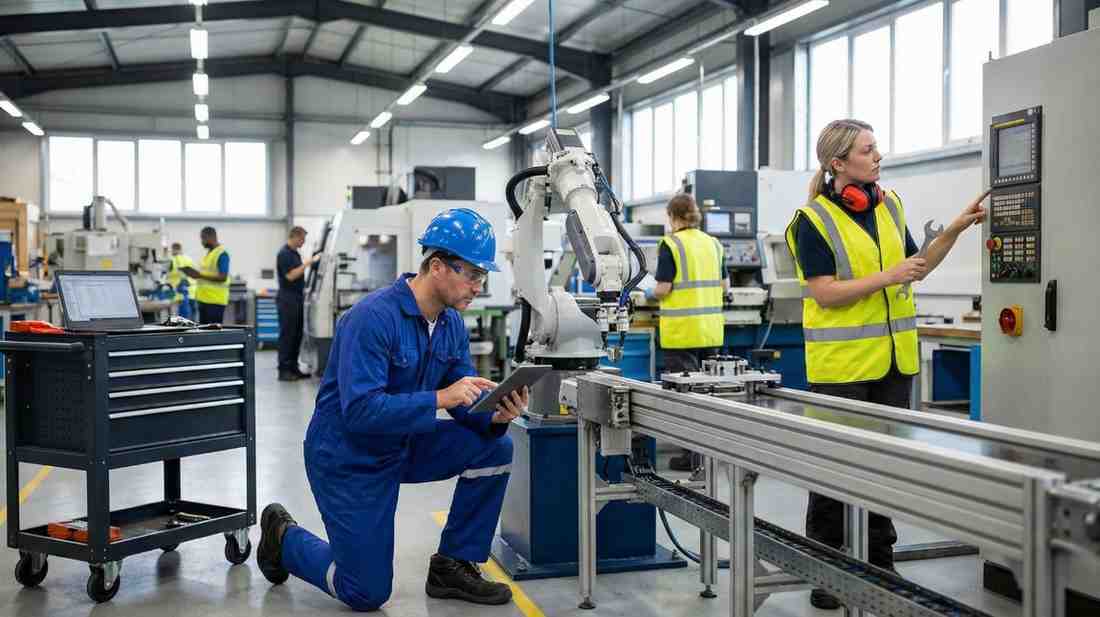
Lean Manufacturing in the UK: A Practical Guide
UK manufacturing faces persistent productivity challenges. Learn how Lean principles drive measurable improvement in production flow, quality, and delivery reliability.
UK manufacturing faces persistent productivity challenges. Learn how Lean principles drive measurable improvement in production flow, quality, and delivery reliability.
UK manufacturing contributes over £190 billion annually to the economy and employs 2.6 million people. Yet the sector faces persistent productivity challenges. Output per hour lags behind competitors in Germany and the United States. Many manufacturers operate with significant hidden waste — overproduction, rework, excessive inventory, and poorly balanced production lines — that erodes margins and delivery performance.
Lean manufacturing addresses these challenges directly. Originating from the Toyota Production System, Lean thinking focuses on eliminating waste, improving flow, and building the capability of the people who do the work. Properly applied, it delivers measurable improvements in OEE, quality, delivery, and cost — without the capital investment that many manufacturers assume improvement requires.
## The state of UK manufacturing productivity
The UK's manufacturing productivity gap is well-documented. The Office for National Statistics reports that UK manufacturing productivity is 20 to 30 per cent below G7 average on an output-per-hour basis. While some of this gap is attributable to structural factors — sector mix, investment levels, regional disparities — a significant portion relates to how work is managed on the shop floor.
In our experience working with UK manufacturers, we consistently find that 30 to 50 per cent of production activity is waste: overproduction that fills warehouses rather than meeting actual demand, changeover times that consume hours when they could take minutes, rework loops that send products backwards through the process, and idle time caused by poor scheduling and material availability.
This waste represents an enormous opportunity. Eliminating even a fraction of it can transform operational performance without additional headcount or capital expenditure.
## Core Lean tools for manufacturing
Value stream mapping is the diagnostic starting point. Map the flow of material and information from customer order to delivery. Measure cycle times, changeover times, inventory levels, and quality metrics at each step. The map reveals where waste is concentrated and where improvement effort should focus.
Standard work stabilises processes by documenting the best-known method for each operation. Standard work reduces variation, makes training easier, provides a baseline for improvement, and ensures that gains from improvement events are captured and sustained.
Quick changeover (SMED) reduces the time to switch from one product to another. In many manufacturing environments, changeover time is the single biggest constraint on flexibility and OEE. Applying SMED methodology can reduce changeover times by 50 to 90 per cent.
Visual management makes the state of production visible to everyone. Real-time boards showing plan versus actual, quality alerts, and maintenance status enable faster response to problems and reduce the management overhead required to keep production on track.
Daily management provides the operating rhythm that sustains improvement. Daily production meetings, tiered escalation, and leader standard work ensure that performance is reviewed, problems are addressed, and improvement actions are progressed every day.
## Implementation approach for UK manufacturers
Start with a pilot line. Select one production line or cell where the problems are visible and the team is willing to engage. Run a value stream mapping exercise, identify the top three to five constraints, and address them through focused improvement events.
Build leadership capability alongside process improvement. Process changes will not sustain if supervisors and managers do not change how they manage. Coach leaders in daily management, Gemba walks, and coaching conversations simultaneously with technical improvement work.
Measure what matters. Focus on a small number of metrics that directly reflect operational health: OEE, first-pass yield, delivery on time, and safety. Avoid the temptation to measure everything — it creates noise and dilutes focus.
Scale through internal capability. Once the pilot delivers results, use the internal team that led it to coach the next area. This builds capability, creates ownership, and reduces dependence on external consultants.
## Making the case for Lean in UK manufacturing
The commercial case for Lean manufacturing is compelling. Typical results from well-executed programmes include: OEE improvement of 10 to 25 percentage points, changeover time reduction of 50 to 80 per cent, inventory reduction of 20 to 40 per cent, quality improvement (first-pass yield) of 5 to 15 percentage points, and lead time reduction of 30 to 60 per cent.
These improvements translate directly to better margins, more reliable delivery, and increased capacity from existing assets. For manufacturers competing in UK and global markets, Lean is not an optional improvement philosophy — it is a competitive necessity.
If you are looking to improve operational performance in your manufacturing environment, book a discovery call. We work on the shop floor alongside your teams to deliver measurable, sustainable improvement.

About the author
Audrey Nyamande
Founder, Tacklers Consulting Group
Audrey is a Lean Six Sigma certified aerospace engineer and transformation coach. She has led improvement programmes in high-stakes engineering, manufacturing, and MRO environments across the UK, helping organisations reduce waste, protect expertise, and build capability that lasts.
View speaker profile: Global Lean Summit 2026Learn more about our teamNext steps
Turn insight into practical operational gains
If this topic matches your current priorities, explore our service pathways or book a focused discovery call.
Further reading
Explore our insights

Leadership
Lean Leadership Principles for Operational Managers
Lean leadership is not about tools — it is about how leaders behave, coach, and create the conditions for teams to improve. Learn the core principles every operational manager needs.

Operational Excellence
Operational Excellence Framework: How to Build One That Holds
An operational excellence framework provides the structure for sustained performance improvement. Learn how to design one that aligns strategy, processes, people, and management routines.
Lean Tools
How to Reduce Rework in Production: A Practical Approach
Rework is one of the most expensive forms of waste in production environments. Learn a structured approach to identifying root causes and building quality in at source.
Lean Transformation
How to Sustain Lean Improvements After the Consultants Leave
The biggest test of any improvement programme is what happens when external support ends. Learn how to build the management routines and capability that make Lean stick.